By Philip Copitch, Ph.D.
You may have heard that tobacco and alcohol advertising is banned on youth oriented programming and in kids magazines, so you think your kids are safe from their influence, but you would be wrong.
While you won't find ads on Sponge Bob or in Highlights Magazine, the tobacco and alcohol companies didn't have to try very hard to find ways around this. A 2001 survey found that the average teen saw 250 ads for alcohol on TV, and 30% saw upwards of 800 ads. Companies know that kids and teens watch programs that are not specifically marketed for children. A recent survey found ads for alcohol on 13 of the 15 most popular shows with teens. This goes for product placement in movies too, like when Super Man is thrown into a Marlboro delivery truck, or there is an ad for Cutty Sark scotch on the brick wall behind the villain. Some people say, well that's okay in movies for adults. Okay - of 145 popular movies reviewed in 2008, 79% of the R rated movies had product placement for tobacco or alcohol, compared to 82% of the PG-13 movies. Movies most of our children over the age of 10 watch.
Magazine advertising has a similar story. Alcohol and tobacco companies know that plenty of teens read magazines such as Sports Illustrated, Cosmopolitan, and even Time. (Many hundreds of schools use it as part of their social science curriculum). These magazines, while not specifically written for teens are nonetheless read by them in large numbers, and the tobacco and alcohol companies know this too. In 2008 the alcohol industry spent 4 Billion - with a B, dollars on advertising. And most of this is marketed to teens. More money is spent advertising alcohol than for soda, potato chips, juice drinks, and sneakers - combined.
One half of all alcohol is sold to those addicted to it or to teens under 18. In fact, JAMA -the Journal of the American Medical Association, found that people under 21 consume 19.7% of all alcohol. Remember, the legal drinking age in the US is 21.
Why is this demographic so important to the alcohol and tobacco industries? Teens have had less experience in judging advertising critically. Most young people have yet to pick a brand. Studies have found that 47-88% of all cigarette advertising is for the three most popular brands with teenagers. That's right, teenagers, not adults. Advertisers have found that there is little point in advertising to existing customers, they've picked the brand they like are not likely to be swayed. That's why you will find little advertising, if any, for alcohol and tobacco in magazines such as Fine Woodworking, or Good House Keeping, publications that teens don't tend to read. If teens aren't reading it, the tobacco and alcohol advertisers have found there is little profit in advertising in it. So yes, they are advertising to your children, clear and simple.
What can you do? Obviously you can't shelter your underage children from all forms of advertising, but what you can do is talk to your children about viewing these ads critically. You can start with young kids, after all, why do companies put toys in cereal boxes or Happy Meals? I have had many conversations in the cereal aisle explaining that we don't buy cereal for the toys, we buy it to eat, and we need to start our day off with good food.
Point out to teens the images that the alcohol and tobacco companies use and discuss why. Let them come up with answers. This begins to lead them down the path to critical thinking. While it won't completely stop them from being influenced by advertising, they will begin to approach ads with a more cautious eye. Seat belts don't stop accidents from happening, but they protect you from worse harm when you get in an accident. The same is true for teaching our children to view ads critically. If they know the tobacco and alcohol companies are trying to manipulate them - and what teen wants adults to manipulate them - they will have some protection when they are "hit" with an ad.
The numbers in this article came from an excellent video put out by Human Relations Media called: Targeted: How Tobacco and Alcohol Companies Try to Get You Hooked. You can watch a short preview of this at: http://a95120.sites.myregisteredsite.com/quicktime/targeted_384k.mov
Showing posts with label effect of advertising. Show all posts
Showing posts with label effect of advertising. Show all posts
Thursday, April 19, 2012


Wednesday, June 22, 2011
New images on cigarette packs
The U.S. Food and Drug Administration recently showed of the new "warning" images that will be on all cigarette packs by the end of 2012.
Some of the images are relatively mild:


"I heard that teens aren't influenced by these scare tactics"
Most people start smoking before age 19. A common reason teens start to smoke is to say "screw you" to their parents, school, or authority in general. This attitude is fleeting for most teens. So over time, knowledge will overcome anger. And advertising (warnings) take time to seep into the mind.


Some of the images are relatively mild:

While some are in your face gross:
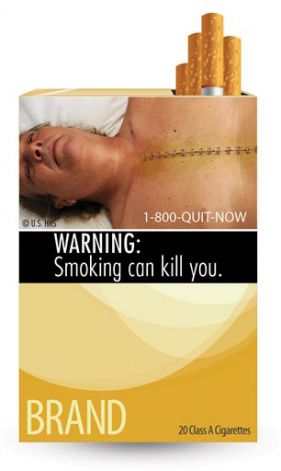


The big question is "Will these warning graphics help people to stop smoking, or better yet, never start?"
The simple answer is yes.
These warning labels are product specific advertisement, and it is well documented that advertisements work. In 2006, the tobacco industry spent $12.4 billion on advertising, not to keep newspapers and magazines afloat, but to replace customers that die from their product. This 12.4 billion represents a doubling in expenditure since 1997. Read the FTC report.
Health and Human Services Secretary Kathleen Sebelius said on June 21, 2011,
Somebody said when they first saw the warnings: ‘These are really gross.' Well, they are. We want kids to understand smoking is gross, not cool. And there's really nothing pretty about having mouth cancer or making your baby sick if you smoke.
"I heard that teens aren't influenced by these scare tactics"
Most people start smoking before age 19. A common reason teens start to smoke is to say "screw you" to their parents, school, or authority in general. This attitude is fleeting for most teens. So over time, knowledge will overcome anger. And advertising (warnings) take time to seep into the mind.

Smoking for teens is a statement. The more the teens see the bigger picture, the less effective their "statement" will be.
A closing thought:
Teens are substantially more likely to smoke if one of their parents smoke. Some parents wonder if their teens learn anything from them... the simple answer is... Yes!
Want to stop... learn more?
Call: 1-800-Quit-Now or go to : www.smokefree.gov
Subscribe to:
Posts (Atom)